超碰在线_午夜免费福利视频_国产浮力影院_av网址在线_中文字幕乱码人妻二区三区_大尺度在线观看_天天干天天干天天_激情伊人_久久精视频_国产日韩av在线_国产一二三区在线观看_成人午夜影视_蜜桃久久久久_五月伊人婷婷_麻豆传媒一区二区三区_天天综合网在线_免费啪啪网_91福利小视频

Position: Home / Our Services /

Our ServicesOur Service

Contact Us

Failure analysis of metal components

With the rapid development of science and technology and industrial production, people have higher and higher quality requirements for mechanical parts. Although the quality of materials and the precision of parts have been greatly improved, the early failure of mechanical parts used in various industries still occurs from time to time. Through failure analysis, find out the cause of failure, and put forward effective improvement measures to prevent the recurrence of similar failure accidents, so as to ensure the safe operation of the project is indispensable.


Applicable products

Automotive parts, precision parts, die manufacturing, casting, forging and welding, heat treatment, surface protection and other metal-related products.


Common failure types

Failure caused by improper design (unreasonable structure design, inadequate design hardness, improper material selection, unreasonable material status requirements);

Failure caused by material defects (loose, segregation, subcutaneous bubbles, shrinkage, non-metallic inclusions, white spots, non-metallic inclusions, surface corrosion, etc.)

Failure caused by casting defects (shrinkage and porosity, whitening and anti-whitening, poor nodularization of ductile iron, slag inclusion, segregation of carbides, casting cracks, graphite floatation, etc.)

Failures caused by forging defects (overheating and overheating, forging cracks, hot brittleness and copper brittleness, forging folding, high temperature oxidation, inadequate annealing, forging white spot, forging streamline defects, etc.)

Failure caused by welding defects (welding crack, incomplete penetration and incomplete fusion, improper welding preheating, slag inclusion and pore, intergranular corrosion, stress corrosion);

Failure caused by heat treatment defects (quenching crack, surface decarbonization, carburizing/nitrogen defect, tempering crack, etc.)

Failure caused by cold forming defects (grinding defects, cutting defects, cold heading defects, punch/extrusion/stretch forming defects, etc.).


Common means of failure analysis

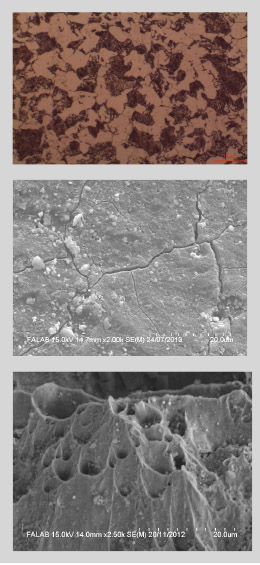
 Fracture analysis:

Metallographic structure analysis

Composition analysis: SEM/EDS; ICP-OES; XRF; direct reading spectrum.

Phase analysis: XRD

Residual stress analysis

Mechanical properties analysis (hardness, tensile properties, impact properties, flexural properties, hardness, etc.)

Inspection and verification of site technology and use environment.


Significance of metal failure analysis

Failure analysis can reduce and prevent the occurrence of similar failure phenomena, thereby reducing economic losses and improving product quality.

Provide information for enterprise technology development and technological transformation, increase the technological content of enterprise products, so as to obtain greater economic benefits.

The failure reasons of mechanical parts are analyzed to provide scientific basis for the identification of accident liability, the detection of criminal cases, the determination of liability for compensation, insurance business, and the revision of product quality standards.